Description
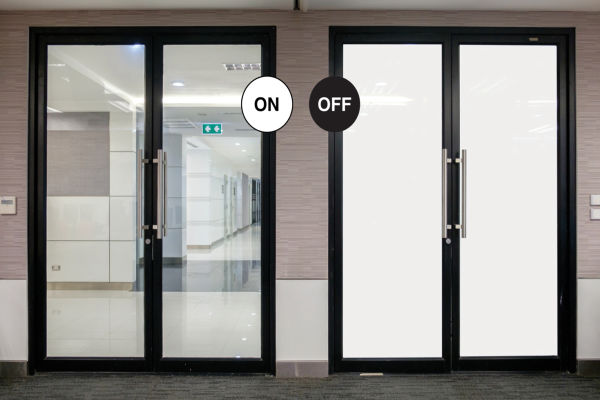
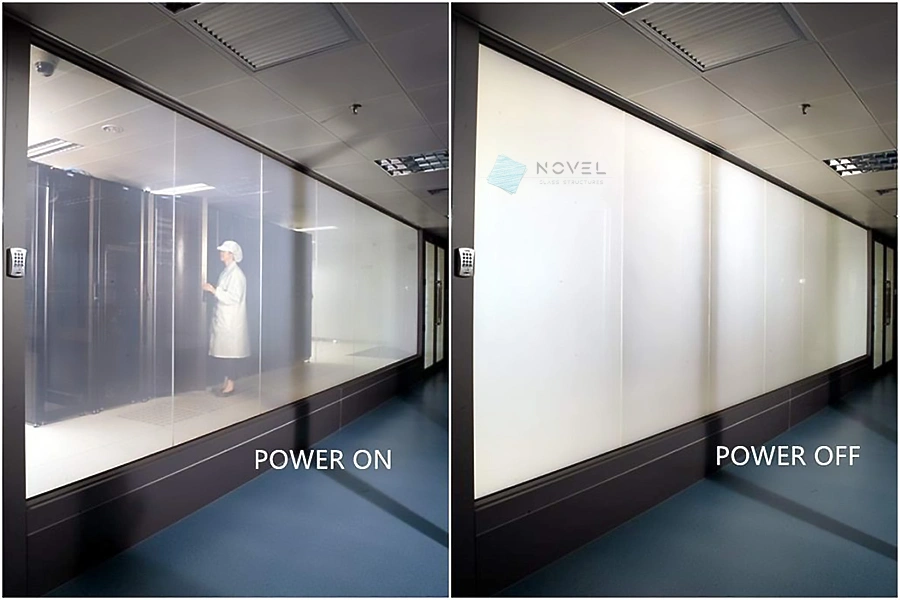
Electrochromic smart glass rapidly changes its light transmission according to the applied electrical current. Before an electrical current is applied, these glasses have a transparent surface, and when activated, they become semi-opaque or completely opaque. The degree of opacity depends on the amount of electrical current applied. Although this transition can take a short amount of time.
LC Smart Glass
LC and PDLC smart glasses are made by placing a thin layer of liquid crystals between two electrically conductive glass panels. Similar to electrochromic glass, this type of glass is transparent before an electrical current is applied.
The difference is that PDLC glass can switch from transparent to opaque within just a few seconds, making this technology faster than other types. LC smart glass belongs to the category of switchable privacy glass and is commonly used in residential, office, and commercial buildings.
SPD Smart Glass
SPD technology uses microscopic particles suspended in a thin layer between layers of glass. When there is no electrical current, the glass is clear and transparent, and when an electrical current is applied, it becomes opaque. The amount of light, radiation, and heat passing through the glass can be controlled.
The main difference between electrochromic, LC, and SPD smart glass is that LC and SPD glass require a continuous electrical current to remain in the opaque state. As soon as the power is cut off or the system is switched off, they return to the transparent state.
Passive Smart Glass
Passive smart glass changes its properties when exposed to external stimuli such as heat and light. Depending on the type of stimulus, these glasses are classified into the following types:
- Thermochromic Glass
- Photochromic Glass
Thermochromic Glass
Thermochromic smart glass changes its light transmission properties according to the amount of heat absorbed. These types of windows are generally used to reduce building energy consumption and control the amount of heat entering the building. Thermochromic smart glass has a wider range of applications due to its ease of installation compared with other types of smart glass.
Photochromic Glass
These glasses change their light transmission properties according to the amount of ultraviolet (UV) radiation reaching the glass. This type of glass is used in sunglasses lenses, building glass, and supramolecular chemistry. One of the main applications of these glasses is in smart windows used in building façades.
Switchable Privacy Glass
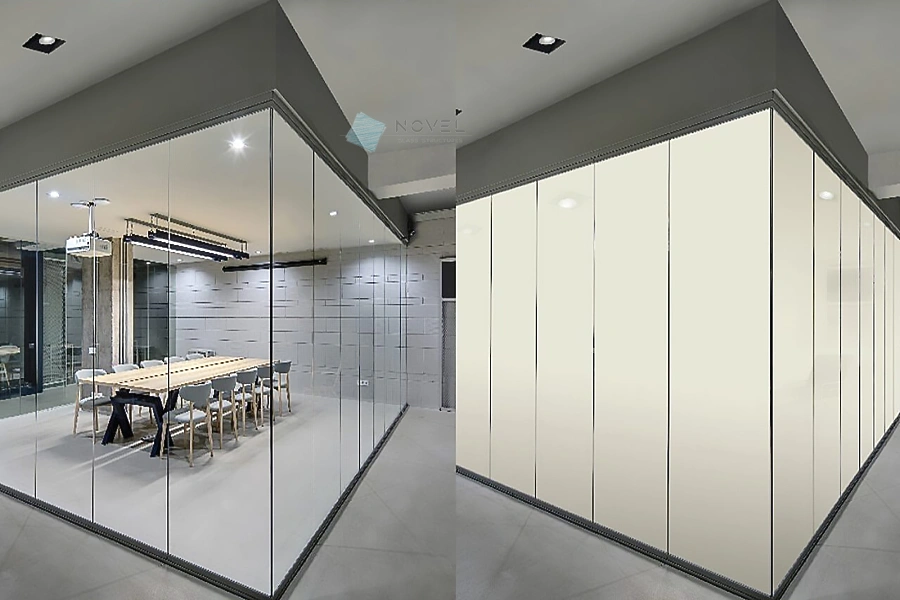
When the power supply is turned on, pressing a button causes the liquid crystal molecules to align, making the glass opaque. After the electrical current is turned off, the liquid crystal molecules become randomly dispersed, and the glass returns to its transparent state.
Applications:
- Privacy in rooms
- Bathroom glass
- Exterior windows
- Conference room windows
- Restaurant entrances and partitions
- Privacy areas
- Balconies
- Room partitions
- Entrance doors
- Hospital doors that require X-ray protective glass, such as ICU doors
Advantages:
- Privacy control in the shortest possible time
- Increased space functionality
- Optical properties that reduce glare and eye exposure to radiation
- Enhanced interior aesthetics
- Long service life
- Low wear and maintenance requirements
Disadvantages:
- Higher cost compared with conventional glass
- Increased heat inside the space due to light absorption by the system (air conditioning is recommended)
Comparison Table of Smart Glass Types
| Smart Glass Type | How It Works | Power Requirement | Switching Speed | Light Control | Common Applications | Advantages | Disadvantages |
|---|---|---|---|---|---|---|---|
| Electrochromic | Changes transparency when an electrical current passes through it | Only when changing state | Moderate (a few seconds) | Gradually adjustable | Building façades, exterior windows | Precise light control, low power consumption | Slower than LC |
| LC / PDLC (Switchable) | Liquid crystal alignment through electricity | Requires continuous power | Very fast (a few seconds) | Mainly for privacy | Office partitions, bathrooms, conference rooms | Complete opacity, high switching speed | Dependent on electricity |
| SPD | Suspended particles between layers of glass | Requires continuous power | Fast | Light and heat control | Luxury vehicles, specialized façades | Controls radiation and heat | High cost |
| Thermochromic | Changes transparency in response to heat | No electricity | Gradual | Temperature-dependent | Building windows | Energy savings, easy installation | No manual control |
| Photochromic | Reacts to UV radiation | No electricity | Gradual | Sunlight-dependent | Building façades, eyeglass lenses | Reduces UV exposure | Performance depends on light |
| Switchable (Liquid Crystal) | Changes molecular arrangement using a switch | Requires continuous power | Very fast | Immediate privacy control | Hospitals, ICU doors, restaurants | Aesthetics, increased space efficiency | Cost and need for ventilation |
Frequently Asked Questions
- What is the main difference between electrochromic smart glass and LC and SPD glass?
Electrochromic glass gradually becomes opaque or transparent by changing the electrical current, while LC and SPD glass have a much faster switching speed. LC and SPD glass also require a continuous electrical current to remain opaque. - Which type of smart glass is more suitable for creating privacy?
LC and PDLC smart glass are suitable options due to their fast switching speed and complete opacity, especially for private spaces such as conference rooms, bathrooms, and office partitions. - What happens to smart glass when the power is cut off?
In LC and SPD glass, the glass returns to a transparent state when the power is cut off. In some electrochromic models, the last state of the glass is maintained and continuous power is not required. - What is the difference between passive smart glass and electrically controlled types?
Passive smart glass operates without electricity and responds only to stimuli such as heat or sunlight (thermochromic and photochromic). It is mainly used for energy savings and natural light control. - Is smart glass cost-effective for use in residential buildings?
Although it has a higher initial cost than conventional glass, increased space efficiency, elimination of curtains and blinds, enhanced aesthetics, and reduced energy consumption can make it an economical and practical option in the long term.
Reviews
There are no reviews yet.